
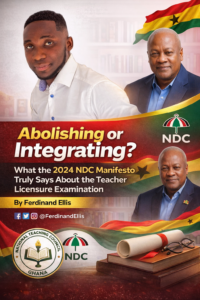
Ferdinand | Education Ghana | March 01 | Abolishing or Integrating? What the 2024 NDC Manifesto Truly Says About the Teacher Licensure Examination
By Ferdinand Ellis | Curriculum Specialist | Education Blogger| Researcher|
Public discussion about the future of the Ghana Teacher Licensure Examination has generated sharp political exchanges. Some claim the 2024 manifesto of the promised to cancel the examination entirely. Others maintain that the position has been misread. A close examination of the document provides needed clarity.
The Origin of the Ghana Teacher Licensure Examination
The Ghana Teacher Licensure Examination was introduced as part of broader efforts to professionalise teaching. The legal basis for teacher licensing is found in the Education Regulatory Bodies Act, 2020 (Act 1023), which mandates the to regulate teacher professionalism, including registration and licensing.
Under the previous arrangement, trainees completed their academic programmes in Colleges of Education or universities. After graduation, they were required to register and sit for a separate licensure examination conducted by the National Teaching Council. Only candidates who passed were issued a professional licence to teach.
This structure meant that some graduates waited several months before writing the examination. Candidates who did not pass were required to re-sit the paper in subsequent cycles.
Concerns Over the Stand-Alone Model
Over time, sections of the public and teacher trainees questioned the need for a separate post-graduation examination. Critics argued that trainees had already completed accredited programs, supervised teaching practice, and final institutional assessments.
The debate gained political attention ahead of the 2024 general elections, as parties outlined proposals for reform within the education sector.
RELATED ARTICLES
- NTC Dismisses Claims of Licensure Fee Increase, Defends Reform of Teacher Licensing
- Upper Manya Krobo GES Announces Vacancies for Three Key Positions
- How GES Handles Student Discipline Cases in Ghana
The 2024 Manifesto Position
In Chapter 5.1.5 of its 2024 manifesto under the theme “Transforming Education,” the stated that it would abolish the teacher licensure examination and integrate the licensing process into the final year examination of teacher trainees.
The wording is specific. The statement does not suggest the removal of teacher licensing as a professional requirement. Instead, it proposes ending the separate examination format and incorporating the licensing assessment into the final year examination process.
The difference is important. Abolishing a stand-alone examination does not mean abolishing licensing. Licensing remains a regulatory standard. The structure of assessment changes.
Reform in Practice
Subsequent developments indicate a shift toward integrating elements of the licensure process into final year assessments. Under this model, professional evaluation forms part of the overall academic assessment, reducing the need for graduates to return for a separate examination after completing their studies.
This approach reflects the integration principle outlined in the manifesto. It allows trainees to complete both academic and professional requirements within a unified assessment framework.
The Ongoing Registration Exercise
Questions have also arisen about the continued registration of candidates for the licensure examination. This situation is largely explained by transitional arrangements.
The ongoing registration mainly applies to:
- Candidates who previously sat for the licensure examination but did not pass
- Graduates who completed their training before the integration reform and did not write the examination
- Degree and post-diploma holders who still require certification under existing regulations
Policy transitions typically include provisions for backlog candidates to regularise their professional status. The continuation of registration exercises therefore does not contradict the integration reform. It addresses individuals outside the new structure.
Reading Policy Text Carefully
The discussion surrounding the teacher licensure examination highlights the importance of careful reading of policy documents. The 2024 manifesto of the speaks to restructuring the examination system, not dismantling teacher professionalism.
Professional licensing remains under the authority of the . What has shifted is the method of assessment, moving from a separate post-graduation examination to an integrated final year process.
When examined in context, the documented record shows reform through integration rather than the cancellation of teacher licensing in Ghana.

♥Copyright Notice: Content on This Website is Copyright Protected. No Part of this Content should be Reproduced without the Consent of the Author(s) or Recognition of the source of the Content.© 2026 Ellis Multimedia: New.EducationGhana.com All Rights Reserved.♥