
Home Blog Page 3

UCC Opens Applications for SWITCH 3.1 Programme to Upgrade Basic Education Degree Holders for SHS Teaching

0


The University of Cape Coast has opened applications for the SWITCH 3.1 Programme, allowing Basic Education degree holders to upgrade their qualifications and become eligible to teach at the Senior High School level in Ghana.


UCC Launches SWITCH 3.1 Programme for Teacher Career Advancement

The has officially opened applications for the SWITCH 3.1 Programme, a specialised teacher development initiative designed for degree holders in Basic Education who wish to upgrade their qualifications and become eligible to teach at the Senior High School (SHS) level in Ghana.

The programme forms part of ongoing efforts to strengthen teacher capacity and provide professional pathways for educators seeking to transition from basic education to secondary education teaching roles.

Applications for the programme are currently open and will remain available until June 2026.


Programme Designed for Basic Education Degree Holders

The SWITCH 3.1 Programme is specifically targeted at teachers who hold a Bachelor’s degree in Basic Education and wish to acquire the subject depth required for teaching at the SHS level.

Through the programme, participants receive advanced subject training and pedagogical preparation aligned with the curriculum requirements of Ghana’s secondary education system.

Successful participants will be positioned to teach specialised subjects in Senior High Schools across the country.


Available Specialisation Areas

The programme offers a range of subject specialisations aimed at addressing teacher needs in the secondary school system. These include:

  • Mathematics
  • English Language
  • Social Studies
  • Other specialised subject areas depending on programme availability

Participants receive intensive academic preparation in their chosen subject area while strengthening their pedagogical knowledge for effective classroom practice.


Opportunities After Completing the Programme

Graduates of the SWITCH 3.1 Programme gain several professional opportunities within Ghana’s education system.

These include:

  • Qualification to teach at the Senior High School level
  • Eligibility for subject-based teaching roles in SHS institutions
  • Opportunity to pursue further postgraduate studies in education or specialised academic fields

The programme therefore provides a pathway for career advancement while contributing to improving subject teaching quality in Ghanaian secondary schools.


Application Period

Applications for the SWITCH 3.1 Programme are currently open.

Interested applicants are encouraged to submit their applications before the June 2026 deadline to secure admission into the programme.


Strengthening Teacher Professional Development

The initiative reflects broader efforts within Ghana’s education sector to strengthen teacher professional development and improve subject expertise at the secondary school level.

By equipping Basic Education graduates with advanced subject knowledge and teaching competencies, the programme supports the delivery of quality education in Senior High Schools nationwide.

Prospective applicants are encouraged to take advantage of the opportunity and enrol in the programme to enhance their professional qualifications and career prospects.


Check flyer below for details

Ghana Makes History as Juventus Duorinaah Becomes First Lawyer who is deaf

0


Juventus Duorinaah makes history as Ghana’s first deaf lawyer after overcoming communication barriers and academic challenges to be called to the bar in 2024.


Ghana has recorded a historic milestone in its legal profession as becomes the first deaf lawyer in the country and one of the few in West Africa.

His achievement marks a significant moment for disability inclusion in Ghana’s legal system, demonstrating that physical limitations do not define intellectual ability or professional excellence.

Despite the demanding nature of legal education and professional training, Duorinaah navigated academic systems that were not originally designed to support students with hearing impairments.


Early Challenges and Determination

Duorinaah’s interest in law began in 2008 during the period he was seeking admission to . Even the admission process presented accessibility challenges.

With the support of his elder brother and a strong personal determination, he pushed forward and later enrolled in the Bachelor of Laws (LLB) programme at the university.

His journey through legal education required exceptional discipline and persistence, especially in an environment where he was often the only deaf student in his class.


After completing his undergraduate studies, Duorinaah further expanded his academic horizon by pursuing a Master of Laws (LL.M.) at in the United Kingdom.

Studying abroad exposed him to multiple legal systems and international perspectives on law and human rights.

However, communication barriers remained a major challenge. At Cardiff University, he studied without sign language interpreters and instead relied on a palantypist, a professional who transcribes spoken lectures into real-time text.

This system demanded constant concentration and patience, as he followed lectures through live transcription while engaging with complex legal material.


Beyond academic hurdles, Duorinaah also faced social challenges. Having last studied with other deaf peers in 2007, he often found himself isolated in lecture halls and social spaces.

Group discussions, informal conversations, and spontaneous classroom debates, which are central to university life, were sometimes difficult to access.

Yet he continued to push forward. With support from friends and faculty members, he stayed committed to his studies and completed his academic training.


Mentorship and Support Systems

Throughout his journey, Duorinaah credits several individuals who shaped his development.

His family played a crucial role, particularly his elder brother who encouraged him during the early stages of his academic journey. His wife also provided steady emotional support during the demanding years of legal training.

At the , he received mentorship from respected legal scholars, including and , who influenced his understanding of law, justice, and human rights.


Called to the Bar in Ghana

Duorinaah reached the pinnacle of his legal training when he was called to the bar at the in 2024.

He is currently completing his pupilage, the final stage of legal training required before fully establishing his legal career.

His accomplishment represents a powerful message for persons with disabilities across Ghana and Africa.


Inspiring the Next Generation

Beyond his professional ambitions, Duorinaah is committed to mentoring young deaf students who aspire to pursue careers in law.

He encourages individuals with disabilities to view their challenges not as barriers but as opportunities to demonstrate resilience and innovation.

“Never see your disabilities as barriers. Instead, view them as opportunities to do something different,” he said.

Duorinaah also calls on parents to invest in the education of children with disabilities and to recognise their potential.

Looking ahead, he hopes to become a judge and contribute to improving justice delivery in Ghana while ensuring that deaf citizens understand and can exercise their legal rights.

His journey stands as a powerful reminder that determination, support, and access to education can break barriers and create new paths for inclusion.


Government Introduces 20% Salary Top-Up for Rural Teachers Under ‘Teacher Dabre’ Programme

0
Government to Construct 600 Basic Schools Nationwide to End “Schools Under Trees” – Apaak


Government announces a 20% salary top-up and accommodation support for teachers who accept rural postings under the Teacher Dabre Programme to improve education access in deprived communities.


Government Announces New Incentive for Rural Teacher Postings

The Government of Ghana has introduced a 20 percent salary top-up for teachers who accept postings to rural and underserved communities as part of a broader strategy to reduce educational disparities across the country.

The policy forms part of the Teacher Dabre Programme, an initiative designed to motivate teachers to work in hard-to-reach areas while improving the quality of teaching and learning in disadvantaged schools.

The announcement was made by , Deputy Minister for Education, during a courtesy visit by top awardees of the Basic Education Certificate Examination (BECE).


Financial and Housing Incentives for Teachers

According to the Deputy Minister, teachers who accept postings to rural communities will receive an additional 20 percent on top of their gross salary.

Beyond the financial incentive, the programme also includes accommodation support to address housing challenges commonly faced by teachers in remote areas.

Dr Apaak explained that the combined package aims to make rural postings more attractive while ensuring that students in deprived communities receive quality instruction.

“The President has a programme that is going to reward teachers who take teaching positions in rural areas. These teachers will receive 20 percent on top of their gross salary as a form of motivation,” he stated.


Policy Rooted in State of the Nation Commitment

The Teacher Dabre initiative was first announced by during the , where the government outlined measures to improve equity in education.

The policy reflects the administration’s commitment to ensuring that students in underserved communities receive the same opportunities as those in urban areas.

Education analysts have long argued that unequal teacher distribution remains one of the major challenges facing the , particularly in deprived districts where schools struggle to retain trained teachers.


Addressing Rural Education Inequality

Teacher deployment in rural areas has historically been difficult due to limited infrastructure, poor accommodation, and fewer professional development opportunities.

By introducing financial incentives and housing support, the government hopes to strengthen teacher retention and improve educational outcomes at the basic school level.

Education experts note that similar incentive schemes in other countries have contributed to better teacher distribution and improved learning outcomes in disadvantaged regions.

If successfully implemented, the Teacher Dabre Programme could help narrow the persistent gap between rural and urban schools in Ghana.


Broader Implications for Basic Education

The initiative is expected to complement other national education programmes aimed at strengthening basic education and improving learning outcomes across the country.

Officials believe that attracting more qualified teachers to rural schools will enhance classroom instruction, reduce teacher shortages, and support the overall development of Ghana’s education system.


Related Stories

  • Ghana Announces New Measures to Strengthen Teacher Training Programmes
  • Government Expands Support for Rural Schools Across the Country
  • Education Ministry Outlines Strategy to Improve Learning Outcomes

Announces 25th Congregation Ceremony for March 27, 2026

0

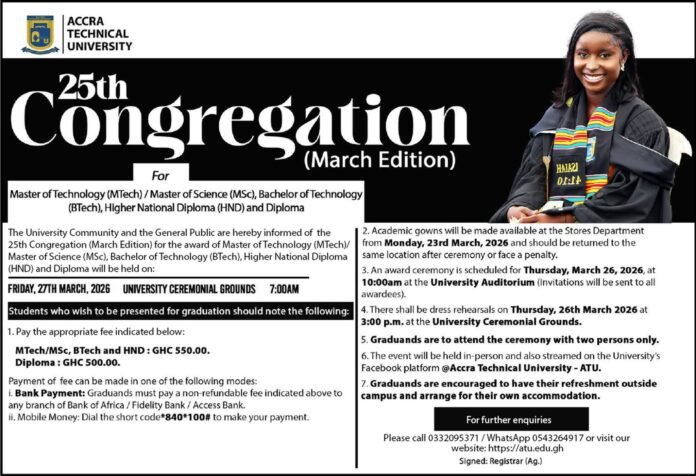
Accra Technical University has announced its 25th Congregation (March Edition) scheduled for March 27, 2026, for the award of MSc, MTech, BTech, HND and Diploma certificates.

(ATU) has officially announced its 25th Congregation Ceremony (March Edition) for the conferment of academic degrees and diplomas to graduating students.

The ceremony is scheduled to take place on Friday, March 27, 2026, at 7:00 a.m. at the University Ceremonial Grounds. The event will recognise graduates from programmes including Master of Technology (MTech), Master of Science (MSc), Bachelor of Technology (BTech), Higher National Diploma (HND), and Diploma.

Graduation Fees and Payment Methods

According to the university’s notice, graduands are required to pay the following non-refundable graduation fees:

  • MTech, MSc, BTech and HND: GH¢550.00
  • Diploma: GH¢500.00

Payments can be made through the following channels:

  • Bank Payment: At any branch of , , or .
  • Mobile Money: Dial 840100# to complete payment.

Academic Gowns and Rehearsals

Academic gowns will be available for collection from the university’s Stores Department beginning Monday, March 23, 2026. Graduands are expected to return the gowns to the same location after the ceremony to avoid penalties.

A dress rehearsal has been scheduled for Thursday, March 26, 2026, at 3:00 p.m. at the University Ceremonial Grounds to prepare graduands for the main event.

Attendance Guidelines for Graduands

The university has advised that each graduand may attend the ceremony with only two guests. This arrangement is intended to ensure smooth organisation and adequate comfort for all participants.

The university also indicated that refreshments will not be provided on campus, and graduands are encouraged to make their own arrangements outside the campus and plan accommodation where necessary.

Ceremony to Be Streamed Online

The congregation ceremony will be held in person and will also be streamed live on the university’s official Facebook page, Accra Technical University – ATU, allowing families and friends who cannot attend physically to follow the proceedings.

The university community expressed anticipation of celebrating the academic achievements of its graduating students as they move into the next stage of their professional and academic lives.


  • Official Website

52 Outstanding Students Honoured as Vice President Jane Naana Graces 2026 President’s Independence Day Awards

0

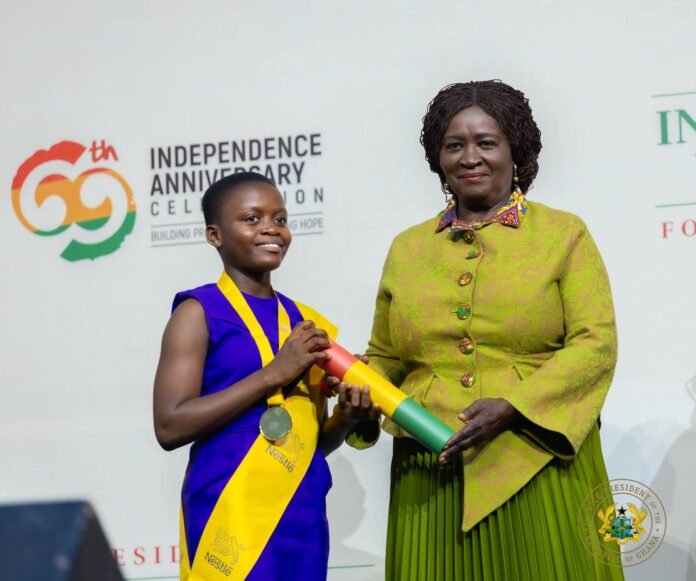
Vice President Jane Naana Opoku-Agyemang joins the 2026 President’s Independence Day Awards ceremony, where 52 outstanding students from all 16 regions were honoured under the theme “Building Prosperity, Restoring Hope.”

The Vice President of the Republic, , participated in the 2026 President’s Independence Day Awards for School Children, held under the theme “Building Prosperity, Restoring Hope.”

The national ceremony recognised 52 exceptional students selected from all 16 regions of Ghana. The awardees were drawn from both public and private schools and included learners with visual and hearing impairments, underscoring the country’s commitment to inclusive education.

Vice President Urges Integrity and Leadership

Addressing the award recipients, Prof. Opoku-Agyemang stated that national prosperity is built not only on sound policies and infrastructure but also on the character, discipline and sense of responsibility of citizens, especially young people.

She encouraged the students to remain committed to their academic pursuits, uphold integrity, respect authority and serve as role models within their schools and communities.

Recognition of Education Partners

The Vice President commended the and the for their sustained efforts in promoting quality education nationwide.

She also expressed appreciation to partners supporting the awards scheme, particularly , for its continued contribution to educational development initiatives.

Government Reaffirms Commitment to Inclusive Education

The government, she noted, remains committed to strengthening inclusive and quality education systems that equip Ghanaian children with the knowledge, skills and values needed to succeed.

The President’s Independence Day Awards remain a key feature of Ghana’s Independence Day commemorations, celebrating academic excellence and inspiring young learners across the country.


Hohoe MP Celebrates BECE Star Fidelia Bigonu for President’s Independence Day Award

0

Hohoe MP Worlanyo Tsekpo congratulates Miss Fidelia Bigonu of Presby Basic School for winning the President’s Independence Day Award for the Volta Region after excelling at Accra Senior High School.

Education advancement in Hohoe has received fresh recognition as Miss Fidelia Bigonu, a former pupil of Presby Basic School, earns the President’s Independence Day Award for the Volta Region.

The commendation was announced by the Member of Parliament for Hohoe, , who described the achievement as a proud moment for the municipality and the entire Volta Region.

Scholarship Support from BECE to Tertiary

On October 14, 2025, the MP awarded Miss Bigonu the Hohoe Education Endowment Scholarship Package. The scholarship was designed to support her education from Senior High School through to her final year in tertiary education after she emerged as one of the three best candidates in the Basic Education Certificate Examination within the Hohoe Municipality.

According to the MP, the initiative forms part of broader efforts to strengthen academic excellence and create opportunities for brilliant but deserving students in the constituency.

Excellence at Accra Senior High School

Miss Bigonu is currently a student at , where she continues to distinguish herself academically.

Her performance has earned her the President’s Independence Day Award for the Volta Region, scheduled to be presented on March 6, 2026, as part of Ghana’s Independence Day commemorations.

Community Celebration Planned

In recognition of her accomplishment, Hon. Tsekpo announced that a special dinner will be held in her honour over the weekend at his residence. The event will host her immediate family, the Municipal Director of Education and her teachers.

He praised her hard work and dedication, stating that her success reflects positively on her parents, her former school and the Hohoe Municipality at large.

Education Development in Hohoe

The MP reaffirmed his commitment to promoting quality education and rewarding excellence within the constituency. The Hohoe Education Endowment Scholarship Package is expected to continue supporting outstanding students in future academic years.

The recognition of Miss Fidelia Bigonu highlights the growing emphasis on academic achievement and targeted educational support within the Hohoe Municipality and the wider Volta Region.


Teacher Found Dead in Suspected Suicide at Assin Fosu

0

A 37-year-old teacher at Faith Academy Basic School in Assin Dompim, Assin Fosu Municipality, has been found dead in an apparent suicide. Police have launched investigations into the circumstances surrounding the incident.

A 37-year-old teacher at Faith Academy Basic School at Assin Dompim in the Assin Fosu Municipality of the Central Region has been found dead in what police describe as an apparent suicide.

The deceased, identified as Emmanuel Kofi Quainoo, was reportedly discovered in his room at Assin Fosu on March 3, 2026, prompting investigations by local law enforcement authorities.

Events Prior to the Incident

Sources at the school indicated that Mr Quainoo had been absent from work for some time and had only resumed duty earlier that day.

Colleagues disclosed that he left the school premises around midday after the second break. He reportedly informed staff members that he was unwell and needed to go home to seek medical attention.

Later in the day, information circulated within the community that he had allegedly hanged himself in his room.

Family Raises Alarm

According to reports, his two daughters, aged eight and seven, returned home from school and discovered him. They subsequently raised an alarm, drawing the attention of neighbours and residents in the area.

The development has left staff, pupils and members of the Assin Fosu community in shock.

Police Investigation Underway

Police have commenced investigations to establish the full circumstances surrounding the death. The body is expected to be conveyed for preservation and autopsy in line with standard investigative procedures.

Authorities have not yet released further details pending the outcome of investigations.

Mental Health Awareness

Incidents of suspected suicide continue to raise concern about mental health support systems within communities. Individuals experiencing emotional distress are encouraged to seek help from qualified health professionals, trusted relatives or recognised support services.


Government to Establish Six Regional TVET Centres of Excellence to Tackle Youth Unemployment

0


SONA 2026: President John Dramani Mahama announces construction of six Regional TVET Centres of Excellence to boost skills training, reduce youth unemployment, and align education with labour market demands.

By Education Correspondent

Technical and vocational training has been placed at the centre of Ghana’s employment strategy, following an announcement that six Regional Centres of Excellence are to be constructed across the country.

President John Dramani Mahama, speaking during the 2026 State of the Nation Address in Parliament, set out the plan as part of a wider reform of Technical and Vocational Education and Training.

The proposed centres are intended to equip young people with practical and industry-relevant skills aligned with the evolving demands of the labour market.

A Strategic Shift Toward Skills Development

For decades, public debate has circled the imbalance between academic qualifications and employable skills. Employers have frequently cited gaps in technical competence among graduates, particularly in manufacturing, construction, engineering, and emerging digital trades.

The establishment of Regional TVET Centres of Excellence signals a deliberate effort to correct that imbalance.

These institutions, according to the President, will serve as specialised hubs for advanced technical instruction, modern equipment training, and collaboration with industry partners.

Aligning with Global Education Frameworks

The announcement comes amid an ongoing review of Ghana’s national curriculum to align with the OECD Future of Education and Skills framework. Education authorities indicate that this alignment will strengthen adaptability, resilience, and innovation within the TVET sector.

By connecting training standards with international benchmarks, government aims to improve competitiveness and mobility within the skilled workforce.

Industry stakeholders have long argued that structured partnerships between training institutions and employers are essential for producing job-ready graduates. The Centres of Excellence are expected to formalise such collaboration.

Addressing Youth Unemployment

Youth unemployment remains a pressing national concern. Technical education has been advanced as a practical route to entrepreneurship, self-employment, and industrial growth.

The proposed centres will focus on hands-on training in sectors identified as growth drivers within Ghana’s industrialisation agenda. Precision, certification, and relevance form the guiding principles.

Education analysts observe that strong TVET systems often correlate with lower unemployment rates and stronger small enterprise development.

Regional Access and Economic Growth

Locating the centres across different regions is expected to promote balanced development and reduce migration pressures toward urban centres.

Access to quality technical training within regional capitals and growth areas may stimulate local enterprise and encourage investment.

The President framed the initiative within a broader policy objective of linking education with production. Training without opportunity serves little purpose. Skills matched with demand create momentum.

Implementation and Oversight

Successful execution will require modern workshops, updated curricula, skilled instructors, and sustainable funding. Monitoring mechanisms and industry advisory boards are expected to guide quality assurance.

The six Regional TVET Centres of Excellence represent a structural intervention rather than a pilot programme. Their long-term impact will depend upon consistent policy support and operational discipline.

In the national conversation on employment, the measure signals renewed confidence in technical education as a cornerstone of economic transformation.


Government to Upgrade 40 Senior High Schools to Ease Congestion and Expand Access

0
SONA 2026: Mahama Announces Plan to Establish Three New Technical Universities

SONA 2026: President John Dramani Mahama announces upgrade of 30 Category C schools to Category B and 10 Category B schools to Category A to decongest Senior High Schools across Ghana.

By Education Correspondent

A measured reorganisation of Ghana’s Senior High School structure has been set in motion, following an announcement in Parliament that forty institutions will be upgraded under a new access and parity plan.

President , addressing the House during the 2026 State of the Nation Address, disclosed that thirty Category C schools are to be elevated to Category B, while ten Category B schools will attain Category A status. Facilities within existing Category A schools are also to be expanded.

The policy is presented as a direct response to congestion within the secondary school system and disparities in institutional capacity.

Rebalancing the SHS Structure

The categorisation of Senior High Schools in Ghana reflects infrastructure strength, academic resources, boarding capacity, and historical performance. Category A institutions often attract high demand, placing strain on facilities and admissions processes.

By upgrading selected schools, government seeks to distribute enrolment more evenly and broaden opportunity across regions.

Education planners have long observed that uneven infrastructure development contributes to pressure on well-established institutions while others operate below capacity. The reclassification and upgrade strategy is intended to correct that imbalance.

Infrastructure and Capacity Expansion

The President indicated that expansion works will accompany reclassification. Laboratories, dormitories, libraries, and classroom facilities are expected to receive attention in order to meet Category A and B standards.

Improved facilities, according to education analysts, can elevate academic outcomes and strengthen public confidence in newly upgraded schools.

Where resources follow status, enrolment patterns tend to shift. That prospect lies at the heart of the reform.

Addressing Congestion

Congestion within certain Senior High Schools has been a persistent concern, particularly since the expansion of secondary education access in recent years. Overcrowded dormitories and strained amenities affect student welfare and instructional quality.

The planned upgrades form part of a broader secondary education reform agenda aimed at expanding capacity while preserving standards.

Observers note that successful implementation will require careful monitoring of construction timelines, procurement processes, and equitable regional distribution.

Equity and Opportunity

The measure carries implications beyond bricks and mortar. Elevating schools in underserved areas may enhance local educational prestige and reduce the compulsion for students to travel long distances in pursuit of perceived quality.

In policy terms, the initiative reflects an attempt to reconcile access with excellence. Expansion without dilution remains the stated aim.

The education segment of the 2026 address outlined several complementary measures, including curriculum reform at the basic level and investment in technical education. Within that framework, the restructuring of Senior High School categories occupies a strategic position.

Whether the upgrades achieve lasting decongestion will depend upon execution and sustained funding. For now, the declaration signals intent to recalibrate Ghana’s secondary education landscape in favour of broader access and institutional balance.


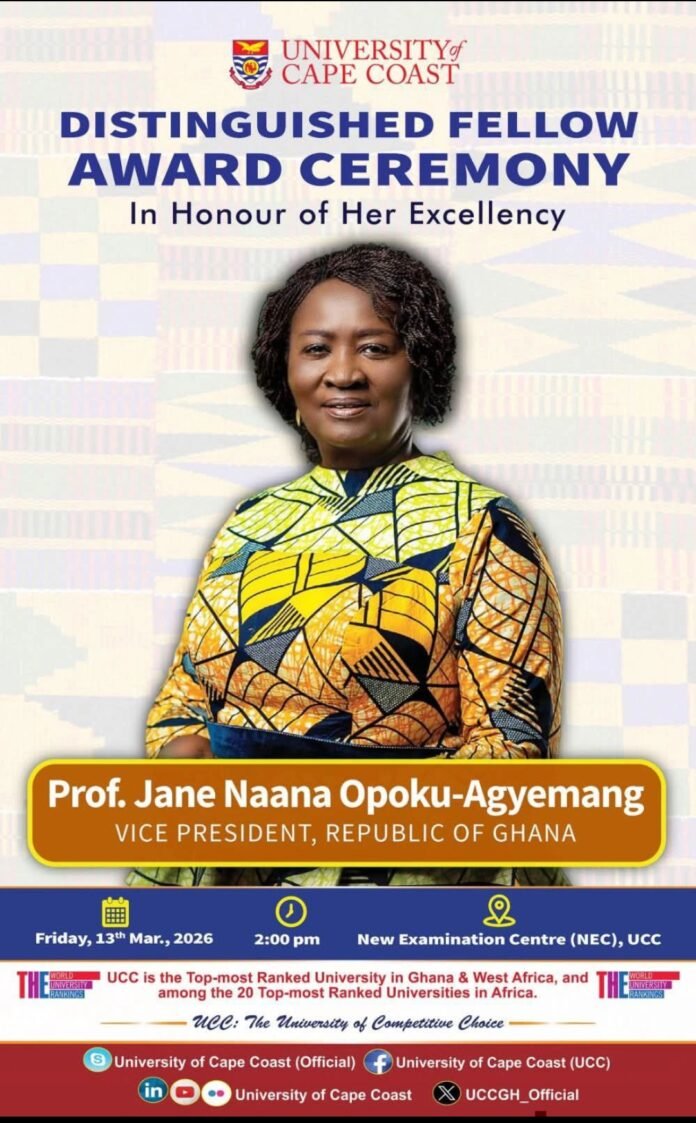
UCC to Honour Vice President Jane Naana Opoku-Agyemang with Distinguished Fellow Award

0

The is set to confer a Distinguished Fellow Award on Vice President at a special ceremony scheduled for Friday, March 13, 2026.

The event will take place at 2:00 p.m. at the New Examination Centre on the UCC campus.

Recognition of Academic and Public Service

The ceremony, to be held in honour of Her Excellency, recognises Prof. Opoku-Agyemang’s longstanding contribution to academia and public service. Before assuming high political office, she built a distinguished career in higher education, including serving as Vice-Chancellor of UCC and later as Minister for Education.

Her academic leadership and advocacy for quality education have been widely acknowledged within Ghana’s tertiary education sector.

Celebrating Institutional Excellence

The University of Cape Coast, often ranked among the leading universities in Ghana and West Africa, describes the award as part of its tradition of recognising individuals whose work has significantly advanced scholarship, governance and national development.

The ceremony is expected to attract senior government officials, members of the university community, students and invited guests.

Further details on the programme lineup and invited speakers are anticipated ahead of the event.